






Achieving high efficiency with ultra-compact power supplies is more critical than ever if you want to manage heat dissipation and maintain reliable performance. Efficiency ratings can be misleading though, as operating conditions significantly affect real-world power supply performance.
Drawing from our comprehensive, free-to-download technical resource, Your Essential Guide to Power Supplies, this article shares our tested guide on AC-DC power efficiency and thermal cooling techniques so you can maximize performance in real-world applications.
Overview
Smaller power supplies require higher efficiency due to limited heat dissipation.
Efficiency varies based on load levels, AC input voltage, and environmental conditions.
Efficiency ratings are often measured under ideal conditions and may not reflect actual performance.
Lower AC input and DC output voltages typically result in reduced efficiency, requiring careful analysis of efficiency curves.
Why do smaller power supplies demand higher efficiency?
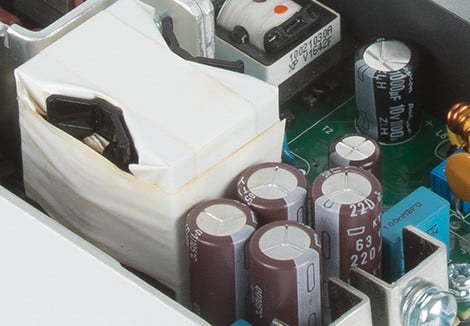
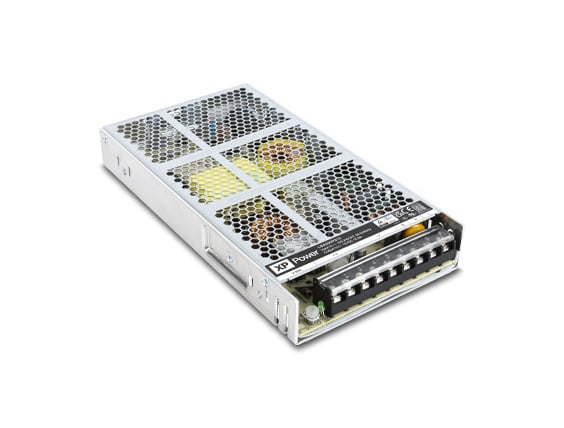
The drive for smaller power supplies goes hand in hand with a need for greater efficiency. There’s a direct relationship here because the smaller the power unit, the smaller the area available for dissipating heat through conduction and convection. Through both measurement and calculation, XP Power has developed a guide to the maximum power loss that can be tolerated for a given size of power supply, based on using convection cooling.
Convection cooling vs. forced-air cooling
This is the loss that keeps all components in the unit operating within their temperature ratings. Figure 1 shows the results. Of course, forced-air cooling can have a big impact on these figures – in some cases a doubling of the power rating is claimed on data sheets. However, in many applications, forced-air cooling is to be avoided, not least because adding a fan to a power supply inevitably decreases its reliability, adds cost, creates noise, and introduces a maintenance headache.
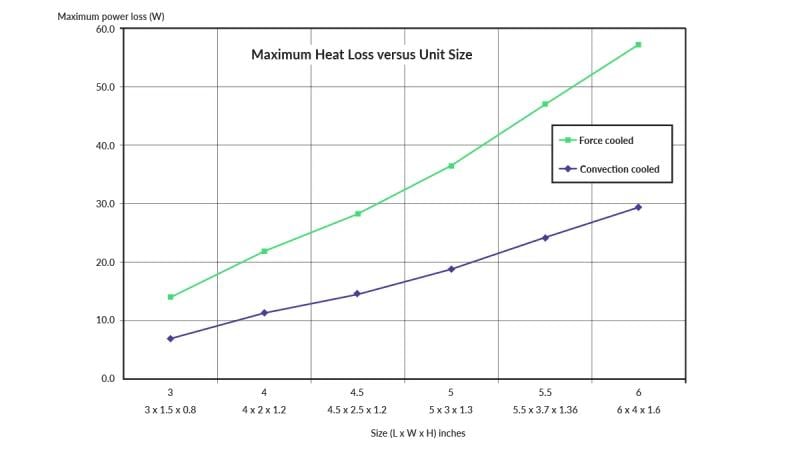
Figure 1: The maximum safe heat dissipation vs. size for AC-DC power supplies
Calculating minimum required efficiency
Based on Figure 1, it’s possible to calculate the minimum acceptable efficiency for a power supply of a given size. For example, if a unit with a footprint of 3 x 5 inches can dissipate 18W, a 100W power supply of this size will need to be at least 82% efficient- 18% wasted power translates as 18W.
Why can power supply efficiency figures be misleading?
Your conclusion might be that any 82% efficient power supply would do the job, but it’s not so simple. Efficiency figures are calculated in different ways, and how efficiency is stated will vary between data sheets. There can be a lot of specmanship going on here. This is hardly surprising, as you would expect any power supply manufacturer to put forward the best case for choosing their product.
The most important thing to remember is that efficiency is affected by the way in which the product is operated and the environment in which it finds itself. The efficiency figure claimed on the power supply data sheet may have been calculated, or measured, under circumstances that were very different from those in which you want to use the unit.
Lack of standardized efficiency measurements
Many regulatory bodies and trade organizations have tried to establish international standards for the way in which efficiency is calculated and stated on product data sheets. An agreed standard has yet to be arrived at.
As a result, power supply efficiency is usually specified based on the operating conditions that are most favourable to the figure concerned, for example, at maximum rated load. Whilst economic necessity will mean that you are unlikely to specify a power supply rated at much more power than you need, it could be that the maximum rating is only needed for a relatively small proportion of the unit’s operating time in your application.
For the rest of the time, it will be operating below full load, and efficiency is likely to be much lower than the headline figure. To assess the impact on heat generation within your product, you’ll need to dig deeper into the data sheet and find the efficiency vs. load curve, if one is provided.
The effect of AC input voltage on efficiency
Another important factor is the AC input voltage to the power supply. At the lowest acceptable AC input, often referred to as ‘low-line’, efficiency is likely to be appreciably lower than when the power supply is operating at its maximum rated input, or ‘high-line’. It is common for ‘universal AC input’ to mean a range of input voltages from 85VAC to 230VAC.
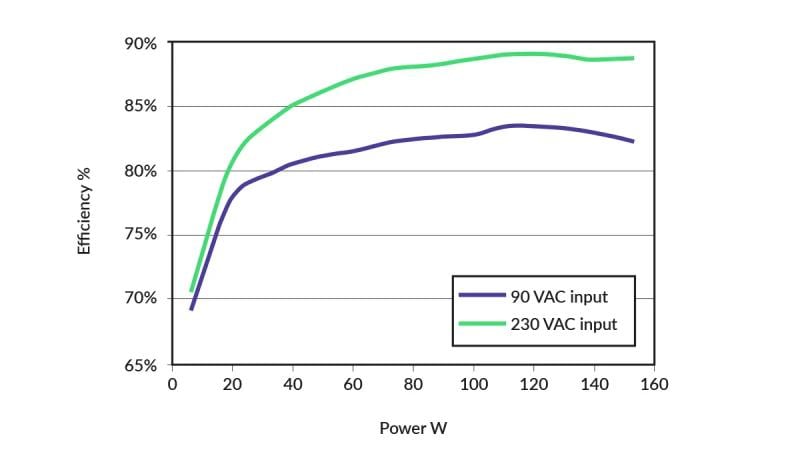
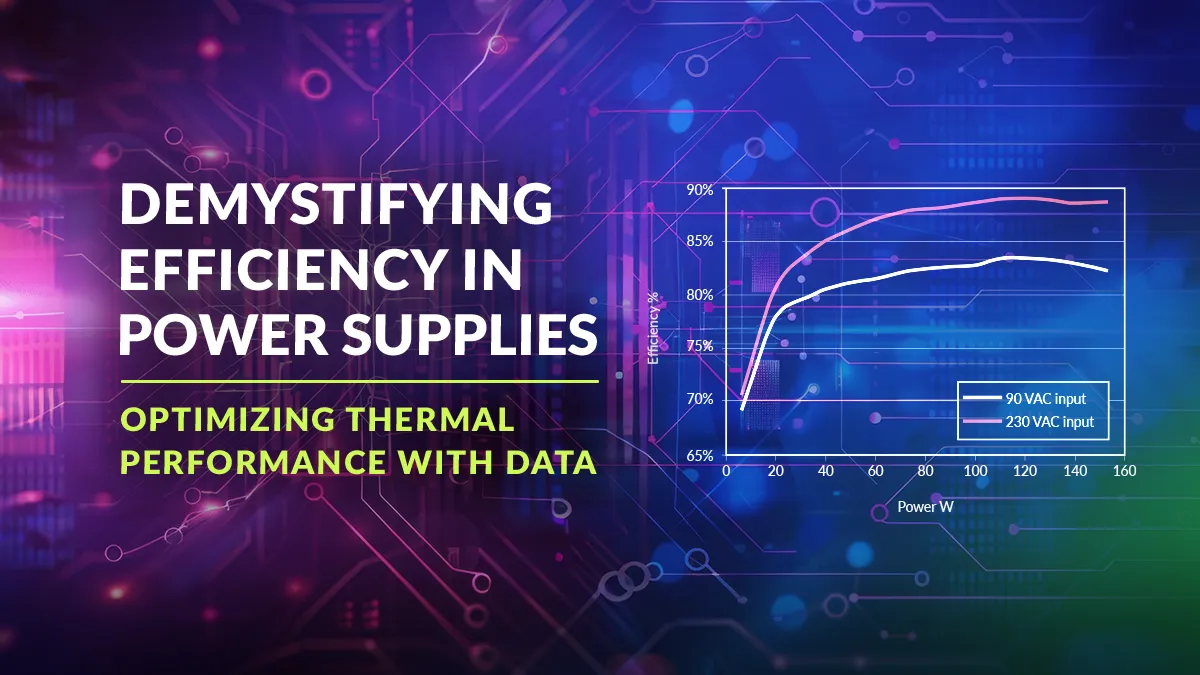
Figure 2: Efficiency vs. load and AC input voltage for a typical 140W, 24V output AC/DC power supply
As you can see from Figure 2, which shows variations in efficiency for a typical 140W, 24 volt-output power supply with respect to load and input voltage, a power supply with a headline efficiency of 88% at highline and 140W load, could be operating at just 84% when delivering the same power from a low-line input.
The less impact that low input voltage has on overall efficiency, the easier it will be for you to calculate the likely efficiency and heat losses that need to be considered in a variety of operating environments.
An example of a power supply that achieves almost a flat efficiency curve over its input range is XP Power’s CCR550. This 550W AC-DC unit is rated up to 94% efficiency at 230VAC input and 91% efficiency at 85VAC input.
The effect of output voltage on efficiency
The final point to be aware of is that for a given input voltage, the efficiency falls in line with output voltage. A shortform data sheet will often refer to a family of products with various DC output options. The headline efficiency figure of perhaps ‘88% typical’ may refer to a unit with 48VDC output. If you are looking for the 5V output model within the range, the efficiency is likely to be somewhat lower. Once again, digging deeper into the detailed data is essential to understand the efficiency that’s likely to be encountered in your application.
Summary
As power supplies shrink, high efficiency is essential for managing heat dissipation and reliability. The guidelines laid out here highlight the limits of convection cooling and the trade-offs of forced-air cooling. Efficiency ratings can be misleading, as real-world performance varies with load, AC input, and output voltage. So, to ensure optimal performance, designers must analyze detailed efficiency data rather than relying on headline figures.
Expand your power expertise! Download Your Essential Guide to Power Supplies for an easy-to-use technical reference guide on selecting and integrating power supplies and DC-DC converters.

Shravan Govindaraj
Shravan Govindaraj is XP Power’s Senior Product Marketing Manager. He has over 8 years of experience in product marketing and technical scales across multiple industries including power supplies, electric motors and HVAC. Shravan joined XP Power in 2022 to develop and implement go-to-market strategies for all XP Power products.


