
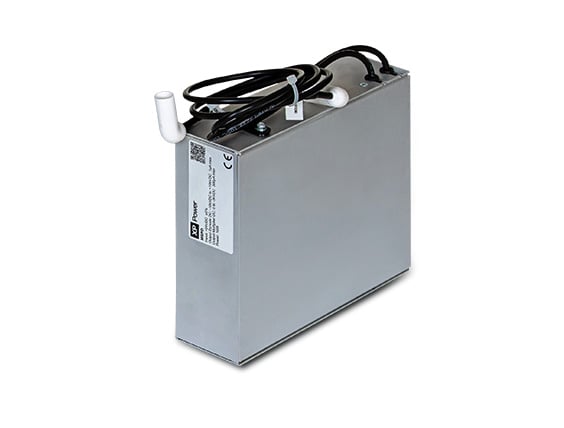







In this blog by our VP of High Voltage Product and Business Development, we explore why high voltage power supplies are fundamental to mass spectrometry performance, how voltage stability and noise affect analytical results, and how XP Power's dedicated mass spectrometry platform helps instrument designers meet these challenges.
Overview
Why high voltage is essential throughout the mass spectrometer
How stability, ripple and polarity switching affect analytical results
How XP Power's mass spectrometry platform simplifies integration and improves reliability
Considering applications beyond mass spectrometry
Precision high voltage at every stage
Mass spectrometers are becoming increasingly sophisticated as researchers analyze more complex samples. Whether an instrument uses a quadrupole, ion trap or time-of-flight (TOF) analyzer, precision high voltage is needed at every stage – from the ion source, through the analyzer, to the detector.
In techniques such as electrospray ionization (ESI), it is the high voltage applied at the source that creates the electric field needed to ionize the sample. High voltage accelerate then focuses the ions, separates them by mass and powers the detector that converts them into measurable signals. Any instability, ripple, or noise can directly affect the results.
Why high voltage stability is non-negotiable
Today’s mass spectrometers often run 16-hour back-to-back shifts, and laboratories expect consistent results without frequent recalibration. Because the measured mass depends directly on the applied voltages, even small changes matter: two samples with the same composition could be identified as different compounds simply because the voltage shifted between measurements. Key performance requirements include:
Long-term stability
If the voltage drifts over time, ion paths and flight times change with it, shifting the measured mass. This is especially critical in TOF analyzers, where mass accuracy depends directly on a stable accelerating voltage.
Temperature stability
Stability over temperature is just as important as stability over time. As the lab and instrument warm up and cool down during the day, a supply with a poor temperature coefficient will drift, so the same sample can give different results at different times.
Ultra-low ripple and noise
Detectors such as electron multipliers, photomultipliers and microchannel plates amplify fluctuations in their supply voltage, so ripple appears as background noise that can mask low-level signals. In the analyzer and ion optics, ripple can broaden peaks and reduce resolution.
Fast polarity switching
Many methods analyze both positively and negatively charged ions in the same run, so the high voltage must reverse polarity between scans. Slow switching or output ringing forces the instrument to pause while voltages settle, reducing throughput.
Arc management
High voltage systems operating in vacuum are susceptible to discharges. Without proper protection, arcs and short circuits can damage sensitive components and interrupt analysis.
As instruments become more complex, designers must also manage grounding, wiring and electrical interference across multiple high voltage outputs.
Meeting the challenge with XP Power's mass spectrometry platform
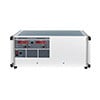
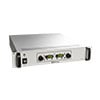
To address these challenges, XP Power has developed a dedicated high voltage platform designed specifically for mass spectrometry applications. Rather than relying on multiple discrete power supplies, the platform provides a coordinated solution for both the ion source and detector, simplifying integration while improving overall performance.
Fast, flexible control for ionization and detector
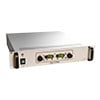
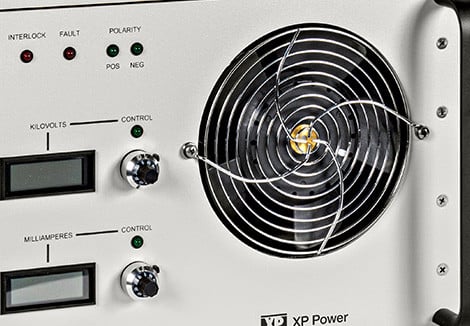
The MS Source delivers a reversible output up to ±6 kV, with a standard polarity switching time of 25ms and an optional 5ms version, allowing rapid transitions between positive and negative ion modes. Analog voltage and current monitors support system diagnostics.
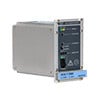
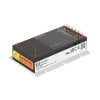
Complementing this, the MS Detector delivers a fast-reversible main output up to ±12 kV for biasing dynode chains, with a secondary adjustable output up to -5 kV for powering electron multipliers. Low ripple, precise load and line regulation (0.01%) and temperature coefficients as low as 25 ppm/°C provide the stability required for continuous operation and highly accurate detection.
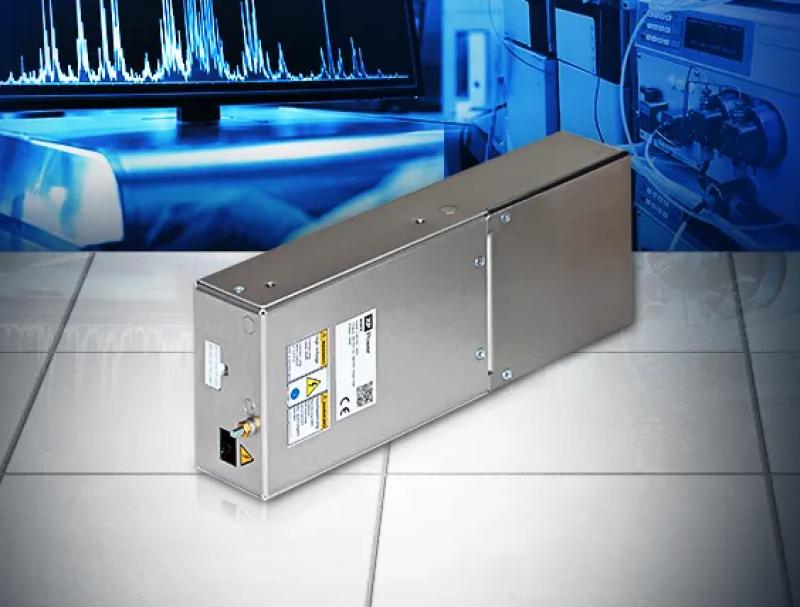
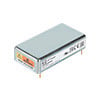
MS Source Series: ±6kV output mass spectrometry source specific power supplies
Protecting against arcs and minimizing downtime
Both series feature comprehensive short-circuit, arc and overload protection. They are designed to meet UL61010 safety approvals and are backed by a three-year warranty.
Applications beyond mass spectrometry
Although designed for mass spectrometry, the same high voltage performance benefits other analytical instruments where stable, low-noise power is critical. These include capillary and gel electrophoresis systems, ion mobility spectrometers, and other analyzers and analytical equipment that rely on precision high voltage and functionality.
Building a foundation for accuracy and reliability
High voltage design choices directly affect performance, development time and reliability, and every instrument has different requirements.
XP Power supports both application-specific platforms such as the MS Source and MS Detector and a broad range of high voltage DC-DC converters. Engineers can choose the approach that best fits their design, backed by the supply chain continuity required for analytical instruments with operational lifetimes of 10 years or more.
Summary
High voltage power supplies play a fundamental role in mass spectrometry, directly influencing analytical accuracy, instrument uptime, and overall throughput. Stable, low-noise power delivery ensures reliable ion generation, precise detection and consistent results throughout extended operating periods.
XP Power's dedicated mass spectrometry platform combines fast polarity switching, exceptional stability and intelligent diagnostics to help instrument manufacturers deliver the performance demanded by today's laboratories and the next generation of analytical research.
Explore our MS Source and MS Detector power platforms designed specifically for high voltage mass spectrometry applications.

Hafiz Khalid
Hafiz is XP Power’s VP of High Voltage Product & Business Development. He has worked in design, application, solution engineering, and product management roles for various products for the past 18 years. Previously, he was Senior Product Manager at XP Power and High Voltage designer with EMCO High Voltage which was acquired by XP Power in 2015.


